You’re lying in bed at 2 a.m., replaying a conversation from three days ago. Or you’re staring at your phone, drafting and deleting the same text for the fifth time. Maybe you’re sitting in your car after work, unable to turn the engine on because your mind won’t stop running through everything that could go wrong tomorrow.
That’s overthinking. And if you’re a guy dealing with it, you’re far from alone.
Overthinking doesn’t always look like anxiety. Sometimes it just feels like you can’t shut your brain off. It’s the constant second-guessing, the mental replays, the endless “what ifs” that eat up your energy and keep you stuck. For a lot of men, it’s invisible—nobody sees it, so it doesn’t feel real enough to address.
But it is real. And it’s exhausting.
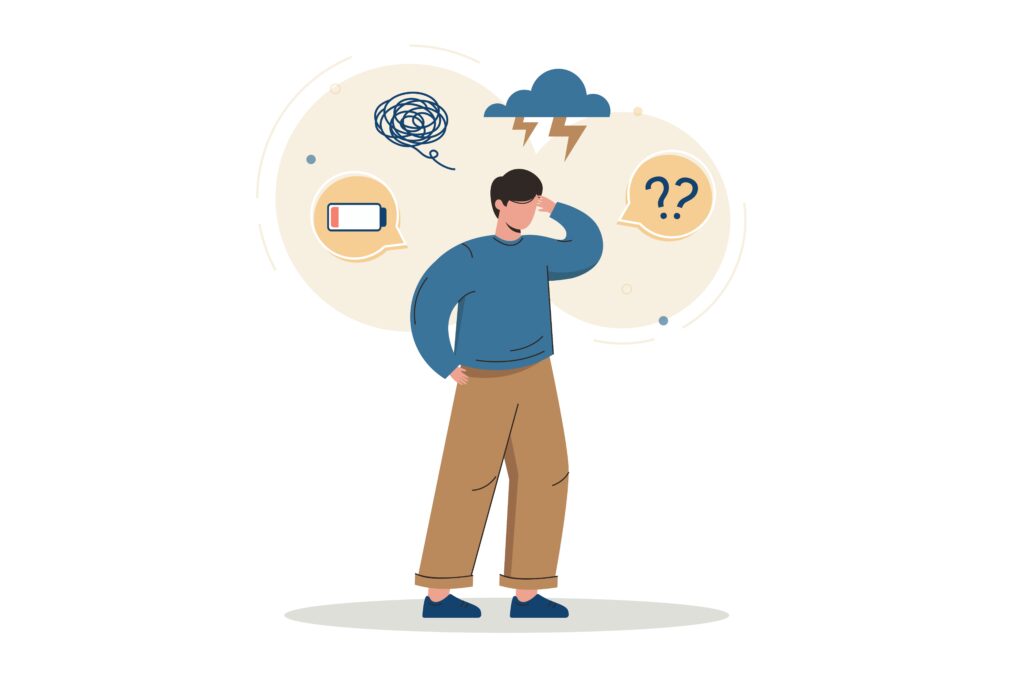
What Overthinking Actually Is
Overthinking is when your mind gets caught in a loop. You analyze the same situation over and over without reaching any useful conclusion. It’s not problem-solving—it’s spinning your wheels.
There are two main types:
Rumination is when you replay past events. You dissect what you said, what they meant, what you should’ve done differently. It’s like watching the same bad movie on repeat, hoping the ending will change.
Worry is when you project into the future. You imagine scenarios that haven’t happened and probably won’t. Your brain treats these imagined outcomes like they’re real threats, which triggers stress responses in your body.
Both can happen at the same time. You might ruminate about a mistake at work while simultaneously worrying about how it’ll affect your career six months from now.
The tricky part? Overthinking can feel productive. It feels like you’re working through something important. But most of the time, you’re just burning mental energy without moving forward.
Why Men Get Stuck in Their Heads
Overthinking isn’t a gendered issue, but how it shows up and why men struggle with it has some specific patterns.
You’re taught to figure it out alone
From a young age, many men learn that problems are something you solve independently. Asking for help or admitting you’re stuck can feel like weakness. So when your mind starts spiraling, you try to think your way out of it by yourself. The problem is, overthinking isn’t a puzzle you can solve with more thinking.
Emotions don’t get processed, they get analyzed
When something bothers you, the default might be to analyze it rather than feel it. You ask yourself why you’re upset, what it means, whether you should be upset at all. This creates distance from the actual emotion, which doesn’t go away—it just sits there while your brain spins in circles around it.
Work and identity are tightly linked
For many men, career performance and financial stability are deeply tied to self-worth. A setback at work isn’t just a bad day—it can feel like evidence of failure. This makes it easy to overthink every decision, every interaction with your boss, every project that didn’t go perfectly.
You’re managing a lot behind the scenes
Society still puts pressure on men to be providers, protectors, problem-solvers. Even when that’s not explicitly expected, the weight of those roles can create mental burden. You might overthink decisions because you feel responsible for outcomes that affect other people—your family, your team, your future.
There’s no outlet
If you’re not talking about what’s going on in your head, it stays in your head. Many men don’t have regular conversations about stress, doubt, or mental loops. So the thoughts just recycle, getting louder and more complicated over time.
What Overthinking Does to You
The immediate effect is mental exhaustion. Your brain isn’t designed to run at full capacity all day with no breaks. Constant analysis drains your ability to focus, make decisions, and engage with the present moment.
Sleep suffers. When your mind won’t quiet down at night, you lose rest, which makes everything harder the next day. You’re more irritable, less patient, and even more prone to overthinking because your brain is already fried.
Physical tension builds up. Overthinking triggers your stress response, which means elevated cortisol, tight muscles, headaches, digestive issues. Your body doesn’t know the difference between a real threat and an imagined one.
Relationships take a hit. When you’re stuck in your head, you’re not fully present. You might seem distant, distracted, or short-tempered. Or you might overanalyze interactions with your partner or friends, creating problems that weren’t there to begin with.
Over time, chronic overthinking can contribute to anxiety and depression. The two feed each other—overthinking makes you feel worse, and feeling worse gives you more to overthink about.
What Actually Helps
Name what’s happening
Just recognizing “I’m overthinking right now” can create a small but important shift. It turns the background noise into something you can see clearly. You’re not trying to stop the thoughts—you’re just acknowledging them as overthinking, not as productive problem-solving.
Set a time limit
If you need to think something through, give yourself a specific window. Ten minutes. Twenty minutes. Set a timer if it helps. When it’s done, move on. This trains your brain that thinking time has boundaries.
Write it down
Get the loop out of your head and onto paper (or your phone). Write the worry, the question, the scenario you keep replaying. Once it’s external, it loses some power. You can look at it more objectively. Sometimes you’ll realize it sounds less catastrophic when it’s written out.
Move your body
Physical activity interrupts the mental cycle. You don’t need a full workout—a walk, some pushups, stretching, anything that shifts your focus into your body for a few minutes works. Movement also burns off the stress hormones that build up from overthinking.
Talk to someone you trust
This doesn’t have to be deep or formal. Sometimes just saying the thing out loud to another person helps you see it differently. A friend, a partner, even a coworker you’re comfortable with. You’re not necessarily looking for advice—you’re breaking the isolation loop.
Challenge the story
Ask yourself: Is this thought based on facts or assumptions? Am I predicting the future? Am I replaying something I can’t change? What would I tell a friend in this situation? You’re not dismissing your concerns, but you’re checking whether your brain is creating problems that don’t exist yet.
Practice a hard stop
When you catch yourself spiraling, physically interrupt it. Stand up. Change rooms. Splash cold water on your face. Do something that forces your brain to shift gears. It sounds simple, but it works surprisingly well.
Build non-thinking time into your day
Your brain needs downtime where it’s not solving, planning, or analyzing. That might be listening to music, working with your hands, playing a game, cooking, watching something entertaining. Give yourself permission to not be productive for a bit.
What Doesn’t Work (But People Suggest Anyway)
“Just stop thinking about it” – If you could just stop, you would. This advice makes you feel like you’re failing at something simple, which usually makes the overthinking worse.
Distracting yourself constantly – Distraction can help in the moment, but if it’s your only strategy, you’re just avoiding the underlying issue. The thoughts will come back.
Telling yourself everything’s fine when it’s not – Toxic positivity doesn’t help. If something legitimately needs your attention, pretending it doesn’t exist won’t make it go away.
Waiting for certainty before taking action – Overthinking often happens because you’re trying to eliminate all risk or doubt before making a move. But certainty rarely comes. Sometimes you have to act with incomplete information.
When It’s More Than Overthinking
If your thoughts are consistently dark, hopeless, or focused on harming yourself, that’s beyond typical overthinking. If you can’t function—can’t work, can’t sleep for days, can’t enjoy anything—that’s a sign something deeper is happening.
Generalized anxiety disorder, obsessive-compulsive disorder, and depression all involve patterns of repetitive, intrusive thinking. These aren’t things you can just think your way out of. They respond to treatment—therapy, sometimes medication, structured support.
There’s no weakness in recognizing when you need help from someone trained to deal with this. A therapist or counselor can give you tools specifically designed to interrupt these patterns and address what’s underneath them.
The Bottom Line
Overthinking isn’t a character flaw or something you’re doing wrong. It’s a mental habit that develops for understandable reasons—often because you care about doing things right, because you feel responsible, or because you haven’t had a way to process what’s going on in your head.
You don’t need to eliminate every worried thought or achieve perfect mental clarity. You just need to stop letting the loops run your life.
Start small. Pick one strategy and use it the next time you notice yourself spiraling. See what happens. Over time, you’ll get better at catching it earlier and redirecting your brain before it gets stuck.
Your mind is a tool. Right now it might feel like it’s using you. But you can learn to use it better.
FAQ
Is overthinking the same as anxiety?
Not exactly. Overthinking is a thought pattern—replaying or predicting excessively. Anxiety is an emotional state that often includes overthinking, but also involves physical symptoms like tension, rapid heartbeat, or dread. You can overthink without having an anxiety disorder, but chronic overthinking can contribute to anxiety over time.
Why do I overthink at night?
Your brain is less distracted at night. During the day, work and activity keep your mind occupied. When you lie down and everything’s quiet, unresolved thoughts surface. Your brain also processes emotions and consolidates memories during rest, which can trigger rumination.
Can overthinking cause physical symptoms?
Yes. Chronic overthinking activates your stress response, which releases cortisol and adrenaline. Over time, this can cause headaches, muscle tension, fatigue, digestive issues, and a weakened immune system. Your body reacts to mental stress the same way it reacts to physical danger.
How long does it take to stop overthinking?
There’s no set timeline. You’re not “curing” overthinking—you’re building skills to interrupt it. Some people notice a shift in a few weeks with consistent practice. Others take longer. Progress isn’t linear. The goal is to catch it faster and redirect more effectively over time.
Should I see a therapist for overthinking?
If overthinking is affecting your sleep, work, relationships, or quality of life, therapy can help. Cognitive behavioral therapy (CBT) is particularly effective at addressing repetitive thought patterns. You don’t need to wait until things are unbearable to get support.